THE DEESIDE FIELD VOL 3 1927 pp 82-85
The Caves and Birds of Fowlsheugh.
FROM NOTES BY THE LATE JAMES REID.
With the intention of making a visit to Fowlsheugh we wend our way down 1 to the old town of Stonehaven, a quaint place with a Dutch looking steeple built for its town-house more than 100 years ago. With its old prison, its Market Cross and picturesque buildings, with its Duck Lane, Marischal Street and Threadneedle Street, it is of interest in several aspects to the ordinary visitor, while it may also profitably engage the attention of the photographer and painter.
Getting on board a boat we soon emerge from the harbour and see in front of us the skull-shaped Downie, 90 feet high, the familiar promontory to the south of Stonehaven. Beyond it lies Strathlethan Bay, curving to the Bowduns, which form another headland where there is the first cave, the Devil’s Kettle 2. Rounding these tide-swept cliffs we have our first view of Dunnottar Castle, whose ruins still give distinction to the huge stack of conglomerate on which they stand and recall much history. There one may still see the window through which 25 Covenanters escaped “doune the rock,” two being killed in so doing.
From Dunnottar and on for two miles we have the cream of Kincardineshire rock scenery. Crossing Old Hall Bay we are abreast of four impressive rock masses, the Brim Cheek 3, the Maiden Kaim, the Ba’ 4 and the Cove Heads 5. The second of these is easily detected by its resemblance to a sugar-loaf, and the Cove Heads, about 150 feet in height, are suggestive of a cathedral. Some of these special features may be located by the use of a large scale map, but even in the 6 in., all the points of interest are not named. Between the Kaim and the Ba’ a great cave 6 has been hollowed out. In storms great seas rush in and completely fill it, and the compression, with loud snoring noise, sends the spray high into the air through holes that pierce the roof. With caution one may sail into this gloomy tunnel for 30 yards and then abruptly turn 7 into complete darkness. By crumpling up a number of newspapers, setting light to them and allowing them to float on the surface, it is possible by the aid of these blazing torches to proceed with great caution a few yards further.
Beside the Cove Heads another cavern has been formed by the sea working along faulting in the rock, where the conglomerate and the porphyrite 8 meet. This cave 9, which is as big as a small church, is above sea level, and may be approached from the land by a steep path. Beyond Tremuda Tongue lies a beautiful bay called Tremuda. On its southern side there is a subterranean passage of 120 yards, known as the Long Gallery 10. It may be navigated at all states of the tide, and entering by the low arched opening we sail towars the dim twilight of the mid-distance and, on reaching it, see far ahead bright light streaming in from the open sea at the other end.
After Tremuda comes Thornyhive, a wild and lonely bay, from which the Turturra Heughs lead on to Wine Cove 11, a name recalling the time when the recesses of this coast were used by smugglers and when Malcolm Gillespie 12, the famous gauger of Skene, had many an adventure in watching and chasing these evaders of the law.
The alternation of headland and bay that has characterised the two or three miles from Stonehaven now comes to an end and the edge of the land straightens out. The cliffs become higher (in some places 200 feet) and are vertical. From Trelung Ness an almost unbroken line of them runs on for a mile. This bold wall rising right out of deep water is the famous Fowls’ Heugh. If we make our visit in the right season, that is in May or June, we shall soon see that the place deserves its name, for by the time we get to Craiglethy, a rocky islet at the north end of the Heugh, we realise that we are invading the privacy of a seabirds’ home. Hundreds are on the wing, and if a sudden alarm is given there may be thousands rising in a cloud. Then the language of the cliff makes itself heard in a babel of raucous calls.
One cannot but be struck by the great scale on which Dame Nature is here renewing the generations. When not in the air or on the water the birds may be seen in rows on the many ledges and in the cup-like holes left by the falling-out of the pudding stones, these natural cavities forming excellent ready-made nests. The clamour of the birds is indeed wild and grand. The screaming of the gulls and kittiwakes and the deep gurring of the guillemots blend in a music that rises and falls, sobs and wails, endlessly night and day through the summer months, till in August when their great task is finished, the birds scatter all over the North Sea and the Fowls’ Heugh is again strangely silent and deserted.
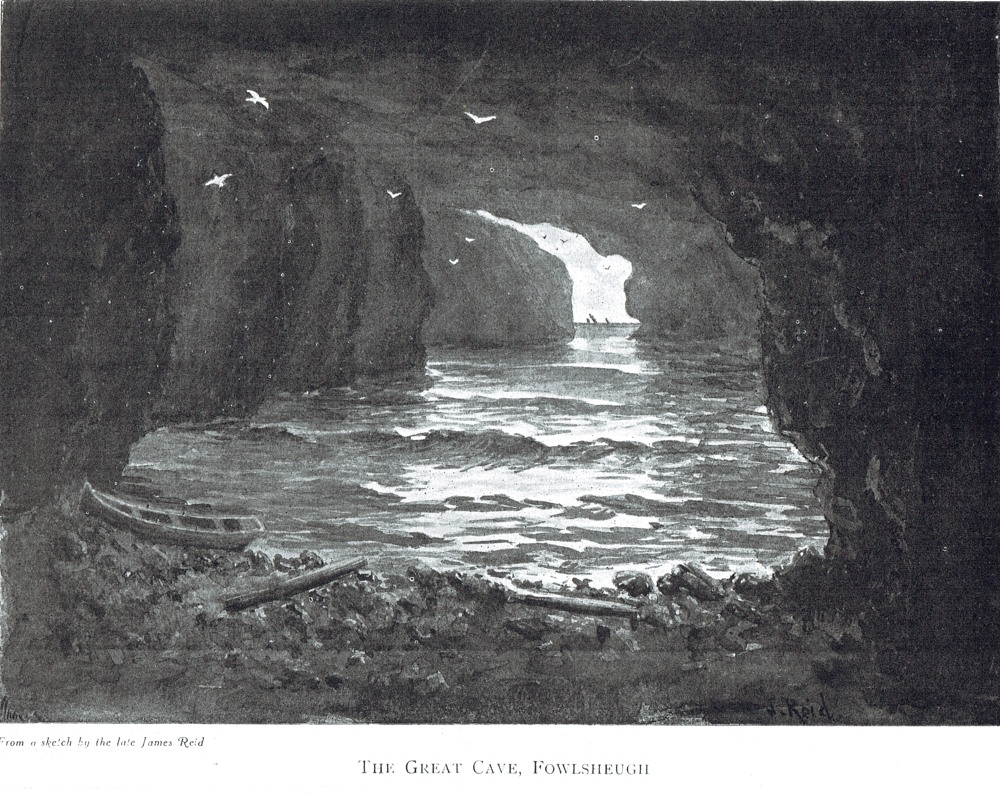
Not far from the North end of Fowlsheugh is the Great Cave or Throch Cove, which can be visited at all states of the tide. The entrance 13, an archway 150 feet wide and 50 or 60 high, is supported by an enormous buttress. Sailing in, we find ourselves in a mighty cavern, resounding like a seashell to the wash of the waves and the weird unearthly cries, as if of lost souls, of the guillemots and puffins that nest inside along with the blue rock pigeon which slips swiftly but noiselessly out as we enter. This cave is about 100 yards in length 14 and in size and architecture is possibly matchless on the east coast of Scotland. The roof is formed in the shape of a dome and 60 feet below it is the restless sea, ever vocal, ever reflecting light and shade. To this watery floor much of the fascination of this scene is due. A special feature of Throch Cove is a huge upright side fissure 15 illuminated from outside with fine effect. This winding passage may be threaded by a small boat at high water and leads to the open sea 16.
Another cave to the south of Throch Cove is of a different character. At low water of spring tides it may be explored on foot for an hour. It is a fine big cave 17 but it is dark and the floor is a dangerous welter of boulders and rock pools. At high water it may be entered by boat but then there are two sharp pinnacles of rock only a few inches below the surface ready to stave in the timbers of a small craft. So, needless to say, Stonehaven boatmen never take visitors there.
As we sail southwards along the cliffs we have always the company of the birds. Guillemots and razorbills often come close up to the boat, moved by curiosity and always under some bold leader. At the least alarm they dive and swim below water at great speed propelled by wings as well as feet. The guillemot resembles the razorbill in habits and appearance (they are both auks) but the bill of the guillemot is pointed against the blunt weapon of the razorbill. The guillemot is sooty-brown above and white below while the other is black above. Both range from Iceland down to the Mediterranean.
The guillemot is easily the first of all the birds at Fowlsheugh. They gather early in spring from all over the sea. They lay but one egg, which is large, pear-shaped and handsome. The tapering prevents the egg rolling off into the sea. No other birds egg shows such variation. Of all birds too that breed in communities the guillemots are the most sociable. The ledges are packed with them in fifties and hundreds, each bird standing over its own egg, which must be kept warm at all costs. They are alert and lively and keep bobbing their heads as if to salute an intruder when alarmed. From this habit the bird is called the foolish guillemot, but no guillemot is foolish enough to nest at Fowlsheugh save where the great enemy must risk his precious life to rob them of eggs or young. As July comes, one can distinguish the musical chirping of the young guillemots on the cliff. In imitation of this the young bird is called a willock and it is supposed that the name of guillemot, which is French, has the same origin.
Puffins are not numerous but they add welcome colour with their red and orange beaks. Their colonies keep together in the caves 18 and fissures near the north end, where also the guillemots and kittiwakes love to nest. The puffin’s food is herring fry and other small fish. It is said to carry transversely in its beak as many as eight fishes at a time. The capture of the first is nothing but how the bird can retain those captured and catch more is another matter. One authority says that puffins will go even fifty miles for food for their young, but this seems hardly credible. Continuous streams of guillemots have been observed coming and going between Fowlsheugh and Muchalls – a distance of eight miles.
The bird population of Fowlsheugh may be a hundred thousand. Formerly it was supposed to have been twice or three times as great. As we pass along the southern portion of the Heugh, we notice at one point the rocks are shaped like the design for a triumphal arch. This is the Cammach 19. Hearabout the cliff is somewhat lower but it still ‘beetles o’er its base into the sea.’ The depth of water, even close in, is very great, being in some places no less than sixty feet. These two factors, the overhanging cliff and the deep water, permit the huge green billows in storms to roll in unbroken and leap up tiger-like at the wall of rock. Then the great weight of water falling down sends a return wave seaward for miles, it is said.
Rounding a point, we are at Henry’s Scorth. Another fine cave 20 is here and is clearly the result of the sea working along a line of joint. There are only a few inches between the boat’s gunwale and the jagged edges of rock. Inside, the cave widens into a large chamber ninety feet high like a cathedral nave and has fine echoes. Another narrow passage leads on to a second chamber. Beyond this you pass into complete darkness. Close by, the sea is trampling on a hidden beach, 140 yards from the entrance and you are actually below ploughed land in a field 140 feet above your head. This cave is really dangerous to visit. A boat caught in the narrows by a sudden swell entering the cave is a doomed boat.
Another serious risk incurred at Fowlsheugh and indeed near any cliffs is from sudden falls of pieces of rock. These do take place now and then and it is therefore not advisable to coast along too close in below.
Several years ago some rock-fishers sitting on Trelung Ness had an unpleasant experience. Two gulls, high up the precipices of Fowlsheugh, began dashing at each other in the air and fought with a loud clamour, when apparently started by the atmospheric vibration from the beating of their wings a fragment fell from the cliff and raised a wave big enough to reach the place where the men were seated.
And so, shipmates all, our short trip is over, unless we look in for a cup of tea at the little fishing village of Crawton,* where once dwelt Kate Morrison said to be the original of Meg Mucklebackit. Then, sun-tanned and drowsy with the strong sea air, with memories of the great precipice and its moods as it lightens and glooms in sunshine and shadow, of its caves and clamorous denizens, we sail home again as the sunset begins to redden in the west.
* Since this was written, Crawton has become a deserted village and now lies in utter ruin.
1 From
the railway station ?
2 This could be Deil’s Kettle or Bowduns N(2)
3 On the map as Dunnimaol
4 On the map as Strabandra Knap
5 The map calls this Tremuda and the bay is Tremuda Bay. The map and James Reid are in agreement on Tremuda Tongue. 'Cove Heads' is probably a reference to the fact that from the sea, the two large cave entrances in the end of Tremuda are very evident.
7 Right – into the north chamber – a lamp might have been better
8 BGS has Tremuda basalt.
9 Tremuda NW(4). It is surprising Reid does not mention the subterranean passage through Tremuda which he could not help but see if he went to this cave.
10 Long Gallery is 164 yards long and not navigable on a springs low tide.
12 Malcolm Gillespie – his Memorial. Many dark deeds and much derring-do by MG as recounted and recalled by MG.
13 Presumably Trough Cove (Middle Entrance) Note that some Doric dialect speakers pronounce the -ough like the -och in loch ie soft and aspirated. Thus Throch is an alternative spelling of Trough. ‘all states of the tide’ is an overstatement as large rocks appear in this middle entrance during springs low tides.
The sketch above is instantly recognisable to anyone who has been inside south tunnel, Trough Cove. The view looks roughly SSE from the south beach. There is a hint of light from the left, just above the rowing boat, coming from the north tunnel. And further along a hint of light from the left, coming from the middle entrance.14 This would be a bit short even for the south tunnel shown in Reid’s fine sketch – see below. All the tunnels and extensions together are currently reckoned to be 323 m, so it is the second largest (to Smoo Cave, Durness) on the mainland coast of Scotland.
15 This probably refers to the north entrance and the SW part of the passage which leads to the beach at the western end of the south tunnel.
16 ‘leads to the open sea’ suggests a through passage from the north entrance, passing the south beach and out from the south entrance. The direction of the south tunnel misses Craiglethy past its south end. Reid’s sketch is from the south beach, looking ESE. It shows some light from the N tunnel – just above the boat – and some from the middle entrance further along on the left.
17 SC3 seems the most likely candidate cave – based on Reid’s description. But it is only 32 m long and it would not take an hour to explore unless one was looking carefully at every rock pool. Spurnell’s Cove is 3 times as long in total, but is mostly supratidal.
18 N Feilden has not seen puffins inside the sea level Fowlsheugh caves. The nearest is the Trelung Ness Subterraneous Passage (N entrance) and a little north of that, Wallace Bridge in the outer part of that cave system. He was told that puffins have been seen using Dovethirl Cove (High) which is near the top of the cliff.
19 The Cammach matches this description.
20 There are, in fact, two caves, of which Henry’s Scorth E Cave matches this description.
